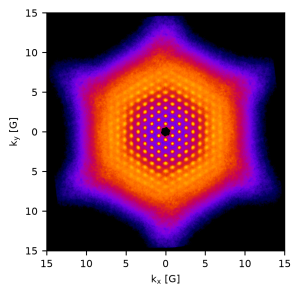
If you diffract electrons or neutrons through a material, they are typically interacting only weakly with the specimen. This is very convenient as it allows you to make a number of simplifying assumptions. However, as soon as you leave known grounds, things start to become more interesting. When studying the diffraction of helium through single-layer graphene, we just stumbled over such a case. In our latest study, we show that for this system the interaction of the particle with the material is two to three orders of magnitude stronger than in an electron microscope. This dramatically changes the shape of the diffraction and gives a first glimpse into a new quantum-to-classical transition.